
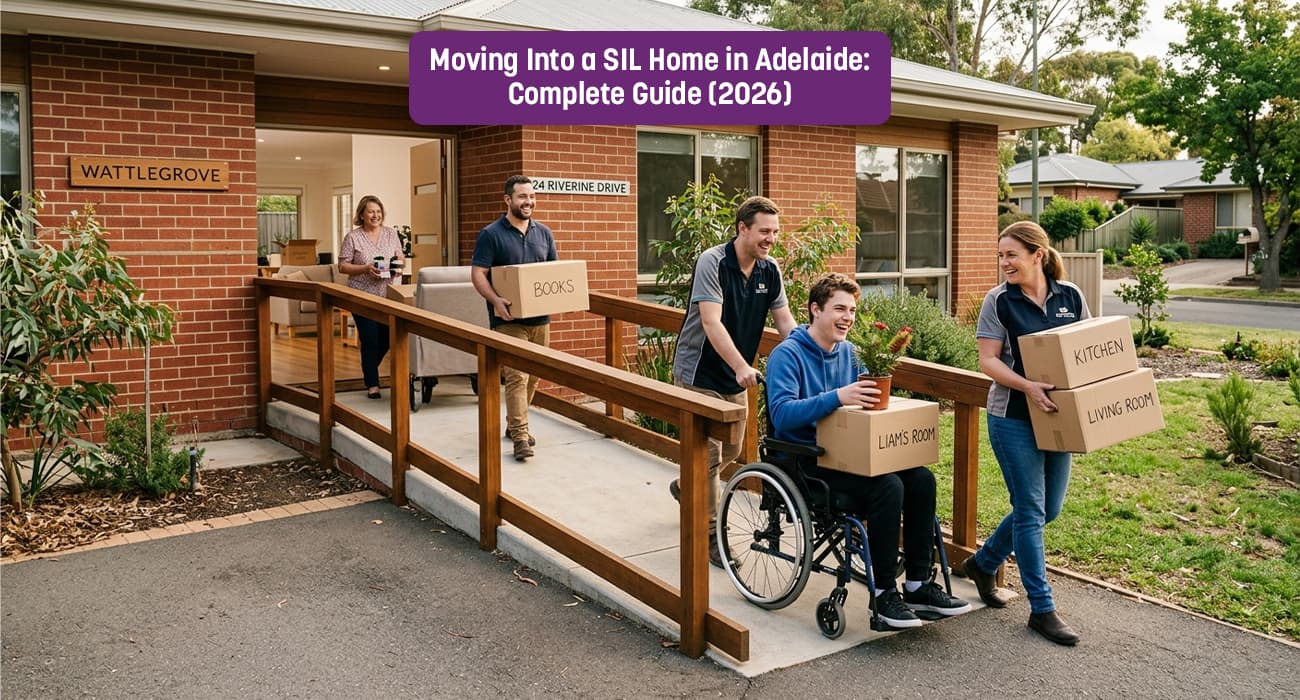
Moving Into a SIL Home in Adelaide: The Complete Guide for NDIS Participants & Families (2026)
Making the decision to move into supported independent living is a big one. Whether you are an NDIS participant ready to take that step towards independence, or a parent researching options for your child, the questions tend to be the same:-What will daily life actually look like?
-Who will my loved one live with?
-How does the funding work?
-Will it feel like home?
At Nurse Aid Australia, we have been helping South Australians answer those questions for over 25 years. We are a registered NDIS provider based in Mawson Lakes, with SIL homes across Adelaide including Clovelly Park, Edwardstown and Brahma Lodge. This guide walks you through everything you need to know about supported independent living in Adelaide — from eligibility and funding to what the first 30 days genuinely look like.
What Is Supported Independent Living (SIL)?
Supported Independent Living, or SIL, is an NDIS-funded support service that helps people with disabilities live as independently as possible — either in a shared home or on their own. The important thing to understand is that SIL refers to the support, not the building. It covers the daily assistance provided by trained support workers, including help with cooking, personal care, medication management, household tasks and getting out into the community.
SIL funding sits under Core Supports — specifically Assistance with Daily Life (Support Category 01) — in your NDIS plan. It does not cover rent, food or utility bills, which are ordinary living costs that every person pays regardless of disability.
SIL vs SDA: What Is the Difference?
This is one of the most commonly confused topics in the NDIS space. Here is a clear comparison:
| SIL (Support) | SDA (Housing) |
What it is | Daily support service | The physical accessible building |
What it funds | Support workers for daily tasks | Purpose-built accessible housing |
Who needs it | Participants needing significant daily support | Participants with extreme functional impairment |
Funded under | Core Supports — Category 01 | Capital Supports — Category 10 |
Can you have both? | Yes — funded separately in your plan | Yes — funded separately in your plan |
How to Get SIL Funding in Your NDIS Plan
To access SIL, you need an active NDIS plan that includes SIL funding under Core Supports. The NDIA assesses eligibility based on your level of daily support needs and whether SIL is the most reasonable and necessary option for you to live safely and independently.
Here is how the process typically works:
- Talk to Your NDIS Planner or Local Area Coordinator (LAC) about your goal of living more independently.
- Engage a Support Coordinator to help you gather evidence, such as an Occupational Therapist assessment of your functional capacity.
- Work with a SIL Provider Like Nurse Aid Australia to develop a Roster of Care — a detailed schedule of your daily support needs used to build your funding quote for the NDIA.
- The NDIA Reviews Your Roster of Care and approves SIL funding as part of your next plan or plan review.
- Choose Your Home and Sign a Service Agreement, then start planning your move.
If SIL is not yet in your NDIS plan, you can request a plan review at any time, especially if your living situation or support needs have changed significantly.
What to Expect When Moving Into a SIL Home
Moving into a SIL home is not like a standard house move. There is a structured process designed to ensure you feel safe, settled and supported from day one. Here is what the journey looks like with Nurse Aid Australia.
Before You Move In
Once you choose Nurse Aid Australia as your provider, we begin with a thorough getting-to-know-you process. We meet with you and your family, review your NDIS goals and daily preferences, and start our housemate matching process. We look carefully at personality, sleep patterns, communication styles and support needs to find housemates who are genuinely compatible — not just whoever has a spare bed.
We also prepare your home before you arrive. Your bedroom is set up to your preferences, any accessibility requirements are addressed, and your support team is fully briefed on your individual care plan before you walk through the door.
The First 30 Days: Week by Week
Days 1 to 7 — Getting Comfortable. Your support team helps you unpack, settle in and establish your daily routine. Mealtimes, medication schedules and household preferences are set together with you — not for you.
Days 8 to 14 — Building Connections. Social introductions with housemates happen at your own pace. Shared activities like cooking meals or watching a movie create natural opportunities for friendships to develop. You also get to know your regular support workers during this phase.
Days 15 to 30 — Exploring Your Community. We begin supporting you to get out into the local area. From visiting shops and parks near Mawson Lakes to attending community groups across Northern Adelaide, this is where independence starts to feel real.
At the end of the first month, we hold a formal review with you and your family to check in and adjust your support plan if anything needs to change.
Inside a Nurse Aid Australia SIL Home
Our Adelaide Locations
We have SIL homes across Adelaide in Mawson Lakes, Clovelly Park, Edwardstown and Brahma Lodge. All homes are selected for their access to public transport, proximity to shops and medical centres, and ability to offer residents a real sense of community and independence.
Active Overnight Support vs Sleepover Support
Not all overnight support is the same, and understanding what is in your Roster of Care matters:
- Active Overnight Support: A support worker stays awake throughout the night, available to assist at any time. Recommended for participants with higher overnight support needs.
- Sleepover Support: A worker sleeps on-site and is available only for urgent needs. Suitable for participants who are largely independent overnight.
We are fully transparent about which level is included in your Roster of Care. No surprises.
What SIL Covers vs What You Pay Yourself
This is one of the most important practical questions families ask. Here is the honest breakdown:
Covered by NDIS SIL Funding | Paid by the Participant |
Support worker wages | Weekly rent |
Personal care assistance | Groceries and food |
Medication management support | Electricity and utilities |
Skill-building and daily living support | Personal clothing and items |
24/7 overnight support (if in Roster of Care) | Internet and phone |
Community participation support | Entertainment and leisure |
Most participants cover rent and living costs through the Disability Support Pension (DSP) or their own income. Your Support Coordinator can help you plan this well before you move in.
A Note for Families and Carers
We know this transition can bring up a complicated mix of feelings — relief, hope, worry and sometimes guilt all at once. That is completely normal.
What we want families to know is that moving into a SIL home does not mean losing connection. You are welcome to visit at any time. We keep you informed throughout the settling-in period, and you remain an important part of your loved one’s life. Many families tell us that once their son or daughter moves into a Nurse Aid Australia home, they see them grow in ways they did not expect — because for the first time, they have a life that is genuinely their own.
Frequently Asked Questions
SIL is the daily support service — the assistance provided by support workers inside a home. SDA is the physical building, purpose-built with accessibility features for participants with extreme functional impairment. They are funded separately in your NDIS plan and you can have both.
From first enquiry to moving in typically takes between 4 and 12 weeks, depending on your NDIS plan review timeline and SIL vacancy availability. Nurse Aid Australia will guide you through every step of this process.
Our matching process is thorough precisely to prevent this. We look at personality, lifestyle, sleep patterns and support needs before placing anyone together. If issues arise after you have moved in, we conduct a formal review and work with everyone involved to find the right solution. Your right to a safe and positive home is not negotiable.
Absolutely. Your bedroom is your own space. We encourage residents to bring personal items, hang photos, and decorate however they like. A familiar and personal environment makes a real difference to how quickly people settle in and feel at home.
Yes. Nurse Aid Australia is fully registered with the NDIS Quality and Safeguards Commission, with registration valid through December 2027. From July 2026, all SIL providers in Australia are required to be registered. Choosing a registered provider means you have the protection of independent oversight and quality standards behind your care.
You have a say in who supports you. During the onboarding process, we introduce you to the support workers who will be part of your regular team and take your feedback seriously. While rosters do change due to shifts and staffing, we aim to provide consistency so you are not meeting a different face every day. Familiar, trusted support workers make a genuine difference to how comfortable and confident you feel in your home.
Your needs evolving over time is completely normal, and your support should evolve with you. If your circumstances change — whether due to a health event, a shift in your goals, or improved independence — we conduct a formal review of your Roster of Care and work with your Support Coordinator to request a plan amendment from the NDIA if more or less funding is required. You will never be left with a support plan that no longer fits.
Absolutely. A SIL home is your home, and your family and friends are always welcome to visit. Overnight stays by family members can usually be arranged with some notice so we can plan support accordingly. We actively encourage families to stay involved — strong family connections are one of the most important factors in how well participants settle in and thrive in supported living.
SIL can be provided in both shared and individual living arrangements, depending on your support needs and NDIS funding. Most participants in Adelaide access SIL in a shared home with one or two housemates, as this is the most common funding model and often creates a built-in social environment. However, if your needs require individual living, this can be explored during the planning process. Talk to our team and your Support Coordinator about which arrangement is right for you.
You always have the right to change your provider. Under the NDIS, choice and control is a fundamental principle — you are never locked in. If you decide Nurse Aid Australia is not the right fit, or you want to explore other options, you can give notice as outlined in your service agreement (typically two to four weeks) and transition to a new provider. We will always support a smooth handover to make sure there are no gaps in your care.
Ready to Find Your SIL Home in Adelaide?
If you or your loved one is thinking about supported independent living in Adelaide, we would love to talk. No pressure, no jargon — just honest guidance from a team that genuinely cares and has been doing this for over 25 years.
We currently have SIL vacancies available across Adelaide. Get in touch today and let us help you take the next step.
Phone: 1300 413 663
Email: info@nurseaidaustralia.com.au
Address: Unit 4/3 Park Way, Mawson Lakes SA 5095
Website: https://nurseaidaustralia.com.au/