
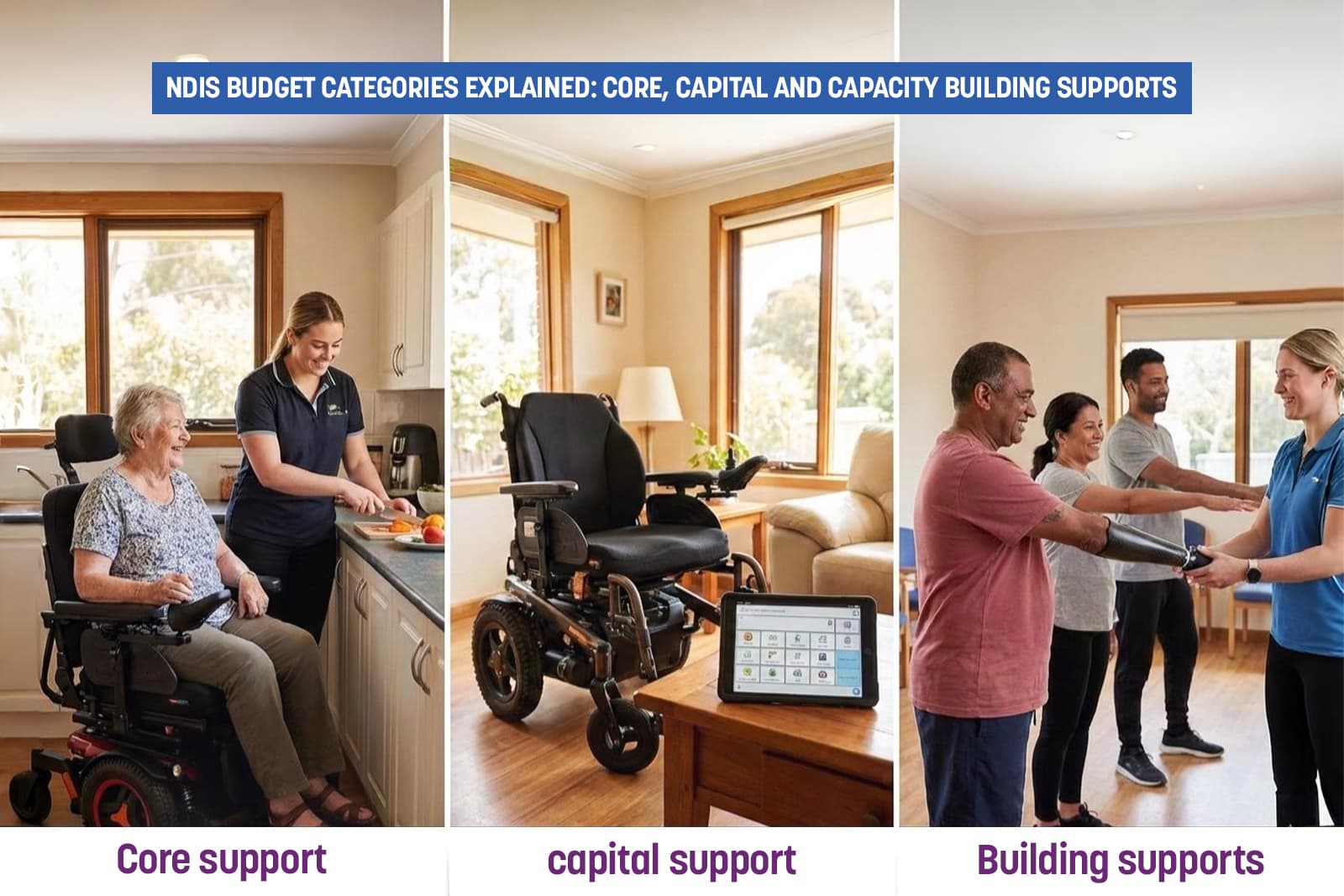
NDIS Budget Categories Explained: Core, Capital and Capacity Building Supports
Introduction: The Foundation of Your 2026 NDIS Plan
Navigating the NDIS plan requires a deep understanding of how support categories interact to provide a cohesive disability roadmap. Under the New NDIS Framework Planning 2026, the NDIA has introduced a “person-centred” approach that focuses on your disability support needs rather than just functional impairment. Whether you are self-managed, plan-managed, or NDIA managed, knowing the reasonable necessary criteria is vital for paving your path toward improved daily living.
What are the 3 NDIS Budget Categories?
The NDIS budget categories act as the foundation of your funding package. Each category sits within your plan to address specific needs and aspirations.
Core Supports
Core support funding is the most flexible funding pool. It covers daily living help, consumables budget, and social participation. It gives you the control to move funds between sub-categories to respond to immediate needs.
Capital Supports
Capital supports are non-flexible stated items. This funding is allocated for high-cost equipment and home modifications. Unlike Core, you cannot reallocate these funds; they are earmarked for specific investments like assistive technology funding.
Capacity Building Supports
Capacity building supports focus on growth and learning. This funding allows you to receive therapy services, specialised training, and employment support to achieve independence over time.
How to Use NDIS Core Supports for Daily Living
The Core support budget provides for Day-to-day help and Routine assistance. In 2026, knowing how to use funding effectively ensures you maintain your routine without hitting budget gaps.
The Four Categories of Core Support Budget
- Assistance with Daily Life: This includes help with personal care, household tasks, and cleaning. For those with complex needs, this often involves High Intensity Daily Personal Activities.
Related Topics :- “The Top 5 NDIS Supports to Improve Your Daily Life”
- Transport: This provides funding for taxis or specialised transport to travel to work or community events.
- Consumables: Use this for purchasing everyday items like continence aids or nutritional products.
- Social/Community Participation: This helps you join a club, attend an art class, or connect with friends.
Is Nursing a Core or Capacity Building Support?
Registered Nursing services typically fall under Core support when they involve High Intensity Daily Personal Activities such as complex wound management or tracheostomy management. However, if the Registered nurse is developing your skills (e.g., learning to self-inject), it may be funded under Capacity Building. At Nurse Aid Australia, our Registered Nursing Services often span both, ensuring clinical oversight while building participant capability.
Maximising Your NDIS Capacity Building Budget
Capacity building supports are goal-oriented funding designed to increase your autonomy.
The Difference Between Core and Capacity Building Supports
Feature | Core Supports (Everyday Essentials) | Capacity Building (Skill-Building) |
Primary Purpose | Daily living help and immediate disability-related needs. | Developing skills and independence to reach long-term goals. |
Flexibility Level | High: Usually a flexible funding pool across most sub-categories. | Low: Funding is usually stated and locked to specific sub-categories. |
Time Focus | The “Now” – maintaining your current lifestyle and safety. | The “Future” – reducing reliance on paid support over time. |
Example Support | A Support worker cooking your dinner. | An Occupational Therapist teaching you how to cook. |
Common Items | Consumables budget (continence aids), Transport, Social access. | Therapy services, Support Coordination, Employment help. |
Budget Rule | Money can often be shifted to where it’s needed most. | Money must be spent within the specific allocated category. |
Clinical Assessments and Improved Daily Living
Under the New NDIS Framework Planning 2026, the NDIA has shifted its focus toward functional domains. This means your NDIS plan is no longer just based on a diagnosis but on how your disability affects your daily living.
- The Power of Evidence: A Functional capacity assessment (FCA) is the most critical tool in your toolkit. Conducted by a Registered professional (like an Occupational Therapist or a Clinical Nurse), this assessment provides a detailed roadmap of your abilities and roadblocks.
- Paving the Way for Funding: The NDIA uses the FCA report to decide what is reasonable and necessary. It shows exactly how much daily living help you need and identifies where Capacity Building can improve your autonomy.
- 2026 Update: With the Instrument for the Classification and Assessment of Support Needs (I-CAN v6) now influencing budgets, having a professional clinical assessment ensures your funding is accurate, fair, and tailored to your actual life.
Investing in Independence with Capital Supports
Capital funding is allocated for big-ticket items and structural support.
Assistive Technology and Home Modifications
- Assistive technology funding: Covers high-cost equipment like wheelchairs, communication devices, and ventilator management tools.
- Funding for home modifications: This helps with installing ramps, widening doorways, or modifying bathrooms to eliminate risks and improve accessibility.
NDIS Reasonable and Necessary Criteria in 2026
Every support in your funding budget must meet the Necessary criteria:
- Assist with Goals: The support must connect to the goals in your NDIS plan.
- Social or Economic Participation: It should help you find a job or join the community.
- Value for Money: The cost must be reasonable compared to the benefit.
- Effective and Beneficial: There must be clinical evidence that the support works.
- Informal Supports: The NDIA looks at what family and friends can reasonably provide.
- NDIS Support : It must not be the responsibility of mainstream systems like Medicare.
Moving Funds Between NDIS Budget Categories
The New Framework Planning gives participants more control but requires strict tracking.
The 3-Month Rule
Budgets are now organised into 3-month funding periods. This helps you manage your spending so you do not run out of funds before your plan ends. Any unused funds roll over within the same plan.
The Flexible Pool
Your flexible funding pool lets you shift money between Core categories. If you save on consumables, you can reallocate those funds to social participation.
The “Stated” Exception
Stated supports are locked. If your plan has earmarked $15,000 for a wheelchair, you cannot use that money for a support worker.
READ MORE :- “How to Maximise Every Dollar in Your NDIS Plan”
Complex Care NDIS: Why Professional Nursing Matters
For those requiring In-home nursing care, Clinical expertise is essential for safety.
Clinical Oversight: Registered nurses manage In-home complex bowel care and ventilator and tracheostomy support to prevent medical emergencies.
- Risk Mitigation: Nursing oversight reduces hospital visits by identifying health issues early.
- Holistic Coordination: Community nursing NDIS works with your plan manager to ensure every piece of your complex care support is effective.
Need Expert Help with Your NDIS Plan?
Managing NDIS budget categories shouldn’t feel overwhelming. At Nurse Aid Australia, we empower you to unlock the full potential of your funding.
Clinical Oversight
We provide detailed clinical assessments to ensure your support categories match your medical needs.
Risk Mitigation
Our Registered nurses monitor your care to eliminate hospitalisations and boost your wellbeing.
Holistic Coordination
We connect your therapy services, daily living help, and nursing into one seamless plan.
Take the first step in navigating your 2026 plan with confidence. Visit Nurse Aid Australia today.
Frequently Asked Questions (FAQ's):
The NDIS budget categories act as the foundation of your funding package. Each category sits within your plan to address specific needs and aspirations.
Core support funding is the most flexible funding pool. It covers daily living help, consumables budget, and social participation. It gives you the control to move funds between sub-categories to respond to immediate needs.
Capital supports are non-flexible stated items. This funding is allocated for high-cost equipment and home modifications. Unlike Core, you cannot reallocate these funds; they are earmarked for specific investments like assistive technology funding.
Capacity building supports focus on growth and learning. This funding allows you to receive therapy services, specialised training, and employment support to achieve independence over time.
Assistance with Daily Life… Transport… Consumables… Social/Community Participation.
Registered Nursing services typically fall under Core support when they involve High Intensity Daily Personal Activities such as complex wound management or tracheostomy management.
However, if the Registered nurse is developing your skills (e.g., learning to self-inject), it may be funded under Capacity Building.
Unlike Core, these funds are usually stated and cannot be shifted between categories without a plan review.
A Functional capacity assessment (FCA) is the most critical tool in your toolkit. Conducted by a Registered professional (like an Occupational Therapist or a Clinical Nurse), this assessment provides a detailed roadmap of your abilities and roadblocks.
The NDIA uses the FCA report to decide what is reasonable and necessary. It shows exactly how much daily living help you need and identifies where Capacity Building can improve your autonomy.
Assistive technology funding: Covers high-cost equipment like wheelchairs, communication devices, and ventilator management tools.
Funding for home modifications: This helps with installing ramps, widening doorways, or modifying bathrooms to eliminate risks and improve accessibility.
Budgets are now organised into 3-month funding periods. This helps you manage your spending so you do not run out of funds before your plan ends. Any unused funds roll over within the same plan.
Your flexible funding pool lets you shift money between Core categories. If you save on consumables, you can reallocate those funds to social participation.
Stated supports are locked. If your plan has earmarked $15,000 for a wheelchair, you cannot use that money for a support worker.